|
|
||
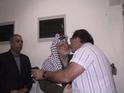
A delegation of Gush Shalom met today (Saturday, 10.04.04) with the Chairman of the Palestinian authority, Yasser Arafat, in order to protest against Ariel Sharon's declarations about his intention to kill him. "We appreciate not only your place in history as the leader of the Palestinian National Movement, but also recognize you as the only Palestinian leader who can make peace with Israel," said Uri Avnery. The delegation included Rachel and Uri Avnery, Beate Zilversmidt, Teddy Katz, Adam Keller, Yehoshua Rosin and Dan Shohet. Answering a question of Adam Keller, the Gush spokesman, Arafat and his Minister for Negotiations, Sa'eb Erikat, spoke about their discussions with Hamas about its participation in the administration of the Gaza Strip after an eventual withdrawal of Israel. Arafat said that the precondition was that Hamas stops all attacks on Israeli civilians. As long as there is no agreement about the political basis ("Two States for Two Peoples"), Hamas cannot take part in the political process, he said. Arafat and Erikat were both very sceptical about the seriousness of Sharon's intention of leaving the Gaza Strip. Among other topics: Arafat reminded the delegation that he sat opposite Sharon and Benjamin Netanyahu at the Wye-Plantation negotiations and reached agreement with them. Saeb Erikat added: "Sharon, then Israel's Foreign Minister, was the spirit of the Wye Conference. He came up with all kind of creative ideas to help reach an agreement. Now he is paralyzing negotiations totally and cutting off the channels of communication. A month ago I met with his Bureau Chief Dov Weisglas. Since then, no contact whatsoever. How does he intend to carry out a withdrawal from the Gaza Strip without coordinating it with us? How does he evacuate settlements without the Palestinian Security Forces on hand to prevent attacks on the evacuating settlers? Does he want the Gaza Strip to become the arena of a civil war, a chaos of gangs and militias? Look what is happening now in the West Bank cities. Sharon has destroyed the Palestinian police stations and disbanded our forces. Look what is happening now in Nablus for example, total chaos. Is this to the benefit of Israel?" At the Wye conference, as will be remembered, Sharon did not shake hands with Arafat. "He cannot forget Beirut," Arafat smiled. In spite of this, Sharon send his son, Omri, several times to Arafat. Sharon threatens to kill me, but he sent his son to meet me. Omri Sharon sat and talked with me here in this room" said Arafat. "I rather like Omri Sharon. He is good guy and open-minded. After Sharon put me under siege in 2002 and his soldiers destroyed most of the compound around here, he nevertheless sent Omri again." Arafat revealed that the late Prime Minister Menachem Begin had proposed to Egyptian President Sadat to hand over the Gaza Strip to Palestinian rule. "Sadat phoned, and passed on Begin's proposal, but I said that I would not agree to separate the Gaza Strip from the West Bank." Saeb Erikat added: "The Gaza Strip cannot maintain itself even for a short time separately from the West Bank. The Gaza Strip now provides only 18% of the GNP, but 52% of our resources are invested in it because it is the poorest and most neglected part of the Palestinian Territory." In the Oslo agreements, too, the PLO agreed to accept the Gaza Strip only together with the West Bank area of Jericho. About Sadam Hussein: "He is not flexible." Arafat described several episodes to illustrate this. Arafat disclosed that last week he had asked former President Jimmy Carter, who had supervised the last Palestinian elections, to be again in charge of monitoring new Palestinian elections. Arafat intends to hold elections for the presidency, the Legislative Council and municipal councils, parallel to the Israeli withdrawal from the Gaza Strip. Erikat added: "That is the only way to stop the chaos and the militia rule and reestablish an effective and legitimate government. Of course elections require the exit of the Israeli army from the Palestinian towns and villages. How can you hold elections when a foreign army can go in at any moment, arrest or kill candidates, break up election rallies, or just prevent voters and election workers from passing from one place to another?" |

|
|
|
|