|
|
||
The Case of Bir 'Ona Until 1967, Bir 'Ona, located on the slope of al Slaiyeb mountain (now Gilo settlement) south of Jerusalem was a small Palestinian community under the jurisdiction of the municipality of Beit Jala.  Although those included in the census were to receive blue Jerusalem ID cards, years passed and no such Israeli ID cards were issued to them. Finally, in 1969 - and only after pressure by the residents - orange-colored West Bank ID cards were issued to them by the Israeli military government/civil administration. At that time, Bir 'Ona residents did not object to receiving the status of West Bank residents, because they were not eager to become legal subjects of the occupying state. For the same reason, the community turned down an eventual offer by Israel, in 1983, to provide them with Jerusalem ID cards. Throughout the 1970s and early 1980s, the community considered itself part and parcel of the 1967 occupied West Bank, just like their neighboring communities of Beit Jala and Bethlehem. They were not aware of the fact that on the maps of the Israeli town planners, Bir 'Ona was part of Israeli-annexed East Jerusalem. In the 1980s, more and more Bir 'Ona residents and newcomers to the neighborhood wished to build new homes and discovered that this was an impossible task. Applicants for building permits at the Beit Jala municipality were informed that they did not fall under the municipality's jurisdiction. When people approached the Jerusalem municipality, their requests for building permits were rejected, based on the argument that the area had not yet been zoned (or was zoned as "Green Land") and that, as West Bank residents, they were not entitled to build on "Israeli state territory". An attempt by the residents in the 1980s to take the issue of building permits in Bir 'Ona to the Israeli court system failed, because the judge stated that he was unable to decide whether or not they were legal subjects of Israel. Families, thus trapped and in urgent need of housing, began to build new homes without Israeli permits. The response was soon to come. Starting from the mid-1980s, demolition orders against the newly built homes were issued by the Jerusalem municipality. In 1990, Bir 'Ona received official notice from the Israeli authorities stating that the community was part of the Israeli state territory. By 1998, two Bir 'Ona homes have been demolished, 17 additional demolition orders are still pending. 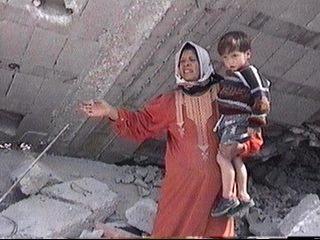 Another picture of the Demolition of the Abu-Maria Home in Beit Umar Since applications for these entry permits were usually turned down, Bir 'Ona residents found themselves living "illegally" in their homes. Israeli soldiers frequently erected checkpoints in the neighborhood and stopped people, residents and visitors, walking in the streets. When they saw their orange West Bank ID cards, they took them away and fined the holder US $150 for illegally entering Jerusalem. Confronted with house demolition orders, the military closure, the immediate threat of land confiscation (both for the growing Gilo settlement and the gigantic bridge serving Road no. 60), and - in the meantime - aware of the Israeli policy of evicting the Palestinian population from Jerusalem, the community formed a Residents' Committee. In 1996, the Residents' Committee set out on the long march for a solution demanding a clear-cut decision by the Israeli authorities: "Either we are residents of Jerusalem and thus entitled to Jerusalem ID cards, municipal services, and building permits, or we and our land must be treated like other West Bank communities occupied in 1967 and handed over to the Palestinian Authority", says Committee Head Nabil Abu Sa'd, "We are not going to let them separate us from our homes and land." Bir 'Ona: Facts & Figures (estimates by the Residents Committee) Size: 1,000 dunums (200 of them built up area) Number of residents in 1967: 150 Number of residents in 1998: 900 Number of residents without Jerusalem ID cards: 500 (70 families) Number of houses: 60-70 (116 housing units) Total Number of demolition orders issued: 19 Number of homes demolished: 2 Source of water supply: Jerusalem Municipality (since 1995)* Source of electricity supply: Jerusalem Electricity Company ** Number of schools: 0 Number of kindergartens: 0 Number of health clinics: 0 Sewage & garbage services: 0 street lightening: 0 Source of water supply: * Before 1995, Bir 'Ona was connected to the water supply system of the Water & Sewage Authority Bethlehem-Beit Sahour-Beit Jala. This system was consequently dismantled by the Jerusalem municipality. Source of electricity supply: ** This company is a formerly Jordanian, now Palestinian company which supplies electricity to Jerusalem (including Israeli areas) and to Israeli settlements in the West Bank. Expenses for the installation of the electric grid were covered by the community and not by the Jerusalem municipality. Image: pics/20.jpg Another picture of the Demolition of the Abu-Maria Home in Beit Umar Negotiations with the Jerusalem municipality and legal efforts on behalf of Bir 'Ona launched in 1996 have born little result: On 13 March 1997, the Residents' Committee and their lawyer Atty. Lea Tsemel met with Jerusalem Mayor Ehud Olmert, the Mayor's Advisor on Neighborhood Affairs, and the Legal Advisor to the Municipality to discuss the practical implications of the 1967 annexation of Bir 'Ona. In this meeting, Mayor Olmert stated that he recognized the urban rights of the residents and the municipality's responsibility for their well-being. He promised the rapid approval of a zoning plan for Bir 'Ona, the prerequisite for municipal building permits. Since then, more than one year has passed and the only practical expression of the municipality's recognition of responsibility for Bir 'Ona is a wave of Arnona (municipal tax) bills which has newly reached the community via the Israeli postal service. "Where are the services, the schools, the kindergartens, the streets, the lights, the garbage disposal, that they ask as to pay for", ask Bir 'Ona residents understandably. Since the residents have abstained from paying the bills, the Jerusalem municipality now issues combined Arnona-water bills so as to step-up the pressure. Also legal efforts aimed at obtaining Jerusalem ID cards for Bir 'Ona residents have brought no more than piecemeal success. Two year's of correspondence with the Israeli Interior Ministry in Jerusalem on behalf of 20 families represented by BADIL Resource Center for Palestinian Residency & Refugee Rights resulted - in early 1998 - in the issuance of temporary 24-hour Jerusalem entry permits to these families. These permits do not entitle the holder to work in Jerusalem, and the question if and when Bir 'Ona residents will obtain Jerusalem ID cards is as unresolved as in 1996. Fearing for their future and trapped in an impossible situation, the Bir 'Ona Residents' Committee and BADIL Resource Center have launched a renewed attempt at putting Bir 'Ona on the agenda of local and international media and human rights activists. "We are not going to sit with our hands folded and wait for our eviction", says Na'im Sa'd, "we want to see our case raised now!" For further details and visits to Bir 'Ona contact: BADIL Resource Center for Palestinian Residency & Refugee Rights, tel/fax. 02-747346, email: badil@baraka.org website: www.badil.org |

|
|
|
|


