|
|
||
 Here, where national conflict intersects with personal lives and Palestinian families try to carve a semi-normal existence under occupation, human suffering is the greatest. For people impoverished, humiliated and living under conditions of extreme instability, owning a parcel of land and a family home assumes an importance far beyond mere shelter; they represent the one place in the world where security and dignity are assured. Pressure to reduce or remove Palestinians from vast areas of the West Bank has increased as Israel inches towards final settlement with the Palestinians. "Area C," the 70% of the West Bank still under Israel's exclusive control, is the focal point of Israel's efforts. It contains the vast majority of Israeli settlements which Israel aims to unite -- with each other and with Israel proper -- through an expansive system of highways, by-pass roads and industrial areas. Control of "Area C" will also allow Israel to isolate the Palestinian population in three or four disconnected enclaves or "Bantustans" (a plan known in Israel as "Allon Plus"), thus foreclosing any possibility of a continuous Palestinian state. A second "front" in this struggle to contain Palestinian housing is Jerusalem. Under the administration of Likud mayor Ehud Olmert, Arab neighborhoods, suffering from an egregious lack of "legal" building over the past 30 years, are being steadily strangled as thousands of acres of their land are expropriated for massive new Jewish satellite settlements and the roads needed to serve them, as well as to provide the city with "open spaces." (see area study of Beir Oneh - LINK to place). Planned confiscations in the Arab neighborhood of Shu'afat, for example, will link the Jewish suburb of French Hill to that of Pisgat Ze'ev, thus creating a contiguous area of Jewish building that effectively halts any development of the Arab north-eastern part of the city. Denial of residency to Arab Jerusalemites (known as "The Quiet Transfer") and stepped-up house demolition are part of this campaign to squeeze the Palestinians out of the city, or at least confine them to isolated pockets. Since the signing of the Oslo Accords in September 1993, some 650 Palestinian homes were destroyed, leaving many thousands of people homeless, destitute and living in fear and trauma. Since the election of Netanyahu's government in May 1996, the policy of controlling Palestinian building has become a full-fledged campaign of clearing "Area C" of Palestinian inhabitants -- a policy that includes driving Bedouin tribes out of the areas which Israel hopes to retain (see area study of Bedouin LINK).
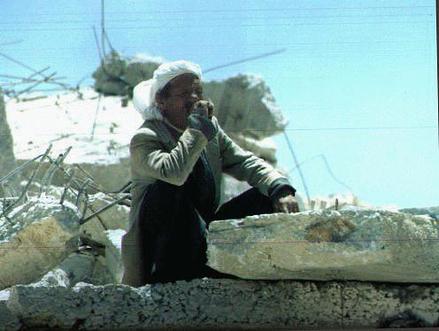
In 1997 alone, according to figures supplied by Israel's "Civil Administration" of the West Bank (as its military government is euphemistically called), 233 houses were destroyed. Between 1000-1500 other homes are today targeted for demolition. In order to give a legal pretext to its actions, Israel has created a Kafka-esque system in which Palestinians have no voice in planning and no access to the administrative bodies that decide where and when houses will be demolished. The zoning laws applied to Palestinian communities date back to 1942, when the British classified the vast majority of West Bank land as agricultural. The basic concept of this zoning scheme remains in effect until this day, meaning that the Palestinian population of "Area C" is confined essentially to urban or village boundaries of 50 years ago, although its present population, including massive influxes of refugees from the 1948 and 1967 wars, has grown four times as large. Previously, the military authorities of the West Bank only granted a small fraction of the building permits required for housing, business, industrial and urban development. Now, housing permits are not issued at all in "Area C", and the political intent of restricting the natural growth of Palestinian towns and villages becomes clear. The Israeli government seeks to retain vast areas of the West Bank, and at the same time the Jewish settlements, including Jerusalem satellite settlements, are rezoned to permit massive construction and expansion. In the early 1990s the Civil Administration of the West Bank prepared "Master Plans" for about 400 Palestinian villages. Rather than addressing genuine needs of population growth, housing and urban services, these plans merely draw tight boundaries around the villages designed to contain instead of develop them. Thus, most Palestinian villages and towns are found in Area A (the 3% of the West Bank under Palestinian control), with pieces in Area B (27% of the West Bank under joint Israeli-Palestinian control). Since the Israeli planning authorities drew such tight boundaries around existing Palestinian towns and villages, any natural expansion that occurs is liable to extend into Area C, for which building permits are routinely refused even if the property is isolated from any Israeli settlement or road. Image: pics/1.jpg The inevitable outcome of this "planning process," then, is to create a situation where building permits are virtually impossible for Palestinians to obtain, the cost in money and time involved in applying (up to $2500 and three to four years) is prohibitive for many families, and the decisions rendered are a foregone conclusion. Nevertheless, desperation caused by extremely overcrowded conditions, as well as the normal aspiration to provide for one's family a house of its own, force many Palestinians to invest their life savings in houses they know might well be destroyed. Sometimes demolition occurs before the house is completed; sometimes upon its completion; and at other times months or years after the family has moved in. Virtually all demolition orders issued to Palestinians are "administrative orders," meaning that they are issued by the Civil Administration of the West Bank, providing a 30 day period for appeal (in Jerusalem Palestinians have 48 hours to appeal to a local court). No appeal that has reached the Israeli High Court has ever been accepted. Our campaign against house demolitions does not argue the legal case of the Palestinian families -- since they have none -- but rather the violation of human rights, basic human needs and human respect that a policy of effectively denying housing to thousands of people entails. The human suffering entailed in the process of destroying a family's home is incalculable. Palestinian families never know just when the demolition crews accompanied by tens of soldiers and police will arrive. They can come at any time of the day or night, though normally demolition does not occur on Fridays or Saturdays due to the Jewish Sabbath. Those are the only times when the threatened families are free of constant fear and anxiety. When the dreaded time comes, the families are often given but an hour's warning to remove their belongings before the bulldozers move in. Sometimes demolition is resisted; at other times the family and their neighbors watch in horror as their home is reduced to rubble. One can only imagine their feelings and thoughts. Whether out of a political conviction that such policies destroy any prospects of peace between Israelis and Palestinians, or out of sense of moral outrage at such injustice, or simply out of human compassion, we ask you to join in our campaign against the demolition of Palestinian houses. Prepared with information from LAW, The Palestinian Society for the Protection of Human Rights and the Environment; B'Tselem, an Israeli human rights organization; Sara Kaminker, and urban planner with Ir Shalem; and Jeff Halper in personal communications with Palestinian families. |

|
|
|
|