|
|
||
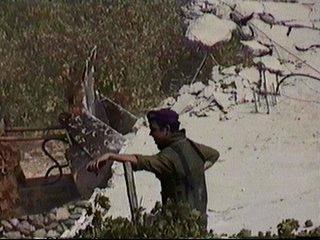 A soldier supervising a demolition (Not related to the case) Before 1967 Anata was connected to neighboring villages -- Hizma to the north, Shu'fat to the west, and al Issawiya to the south -- all of which bounded the northern peripheries of Jerusalem. Its residents made their living from its 30,542 dunams of agricultural land and from stonecutting. Following the 1967 war, half of Anata was incorporated into the expanded municipal boundaries of Jerusalem and half was left as a part of the West Bank. About a third of its population of some 12,000 hold Jerusalem identity cards, while the other two-thirds are classified as West Bank residents, with no access to Jerusalem -- including "Jerusalem" parts of Anata -- in times of closure. In order to contain any possible expansion of the village, the Israeli authorities expropriated some 20,000 dunams from Anata in order to build the West Bank settlements of Alon, Kfar Adumim, Almon and Ma'aleh Adumim which, together with their service roads and the Anatot military base, completely circumscribe the village, which is isolated from its remaining agricultural lands. Most of Anata's work force has been forced to find employment in Israeli factories, although the effective blockade of the village from Jerusalem has made employment difficult. Confined to a small part of their traditional lands, crowding in Anata has become chronic. Some 23 demolitions orders have been served on Anata residents who have been unable to secure building permits yet have been forced by their untolerable conditions to build "illegally." Some of these orders have been issued by the Jerusalem municipality; others, where Anata expands into the Israeli controlled "Area C" of the West Bank, by the Civil Administration. Both Isma'il and N'tisar al-Shawamreh come originally from the area of Hebron, where Isma'il finished 10 years of education and N'tisar eight before they married. Better prospects of employment led them to move to Anata. 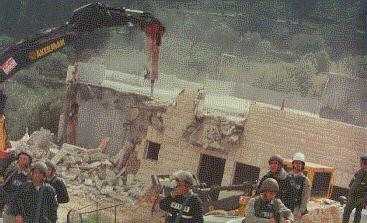 Another demolition site (Not related to the case) In 1993 they bought a half a dunum of land on the southern periphery of the village from a local landowner and applied to the Israeli Civil Administration for a permit to build a house. After a long period of waiting the permit was refused on the grounds that the land -- a rocky, steep area that has never been farmed -- is zoned as "agricultural land," or at any rate would be approved for only one house. (If there is a Master Plan for Anata, the residents have never seen it.) Moreover, while some of Anata is within the Jerusalem municipal borders and other parts are within "Area B," of joint Israeli-Palestinian jurisdiction, the al-Shawamreh's plot extends into "Area C," which is under exclusive Israeli control. Unable to remain in such cramped quarters, Isma'il raised loans from friends and family, dipped deeply into his $800 a month salary and managed to raise $40,000 to build a four-room house. In February, 1997, soon after the al-Shawamreh family moved into their still-to-be completed home, they received an administrative order informing them that their house will be destroyed in 96 hours. Although he has retained a lawyer, Isma'il is afraid to go to court to appeal the order. "I know I will lose the appeal," he says, "and then what? I'm afraid that by calling attention to my case the authorities will come immediately to knock down my house." He shrugs his shoulders, smiles sheepishly and admits: "I just don't know what to do." His only visible defense is a letter to the Israeli Civil Administration from the Palestinian Authority pointing out that the final disposition of "Area C" has still to be decided in negotiations, and Israel is constrained from "creating facts" on the ground. "What will I do if they destroy my house?" Isma'il asks. "Winter is coming, what can I do with the kids?" The tension is almost unbearable. "We live in fear and uncertainty. Its as if every man waits his turn [to have his house destroyed]." Isma'il then reflects and adds bitterly, almost in resignation: "It's no use. There's no life here. No matter what we do we can't win. They tell us to get building permits and we try. They tell us to pay taxes to Israel and we do. We work in their settlements and their factories. We are not active in politics and do not demonstrate or make trouble. Still they make life impossible for us, as if they simply want us to disappear." |

|
|
|
|


