|
|
||
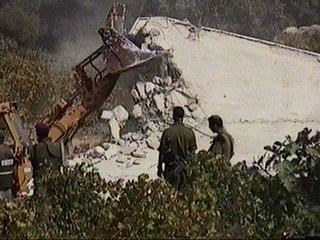 Soldiers supervising demolition (Not related to the case) The village of Issawiyeh was founded some 400 years ago a couple miles north of the Jerusalem's Old City. In 1967 it covered an area of 2,600 acres which was used for housing, agriculture and grazing. After the 1967 war, when Jordanian East Jerusalem was annexed to Israeli West Jerusalem, fully 94% of its land (2437 acres) was expropriated for the construction of Israeli neighborhoods (the expansive French Hill area of apartment blocks) in particular, portions of the Hebrew University, West Bank settlement, an army base and major roads. Much of that land still remains vacant for further use, but the inhabitants of Issawiyeh have no access to it, even for grazing. Instead, they were left with a mere 166 acres, most of that concentrated tightly around the village's already existing homes and other buildings, making any further growth and expansion difficult. The Master Plan of Issawiyeh, approved by the Jerusalem municipality in 1993 with no input from the local residents, removes another 43% of that land (72 acres) for roads, public buildings and "open space," leaving only 94 acres -- or less than 4% of its original land -- for housing. Half of that is already built upon, and of the other half (47 acres) includes a wide swathe through Issawiyeh's center along which building is severely restricted because of its proximity to the army base. In addition, some 40 homes have been demolished in Issawiyeh since 1988, and another 43 demolition orders are awaiting execution. The people most directly affected are among the poorest of the village, those who build their houses on their own property, but whose lands fall outside the tight ring of the "approved" village core. While it is thus true that their houses are "illegal," a combination of a Master Plan that does not allow natural village growth and the difficulties of acquiring building permits from the municipality makes it virtually impossible for Issawiyeh residents to build homes for their families, one of the most fundamental of human rights. Issawiyeh's residents pay their full share of arnona, the municipal property tax, plus other fees for electrical and other services. Still its 6000 inhabitants receive far fewer services than do their Jewish neighbors living on the village's expropriated lands. No road or side street has been built since 1967, forcing residents to drive and climb over rocks and enormous potholes to get to their houses, and there are no sidewalks. The village had no sewage system until, in 1996, the villagers constructed their own using materials supplied by the municipality. Issawiyeh has no public parks, no playgrounds for children and only a rudimentary dirt soccer field. The two local schools are so overcrowded that classes are held in rented apartments. There is no program of pre-kindergarten education that is universal in the Jewish part of Jerusalem, and Issawiyeh's schools have no libraries, labs or gyms. There are no plans for new school construction. Artef Obeid was born in Issawiyeh in 1964 and makes a living driving villagers to work in a mini-van. His wife, Suhad, was born in Jericho in 1967 and is at home. For the first twelve years of the marriage the Obeids lived in his mother's home together with three other married brothers and their families. In 1987, after the birth of his first son, Artef built a small house on his family's land. He did not apply for a building permit. "Applying for a permit is very expensive," he explains. "I would have had to hire a surveyor, pay a large fee and most likely would have had legal expenses as well. That doesn't bother me, but none of my neighbors who had applied for permits received them, so I thought, 'What's the point? Why should I spend my hard-earned money needlessly?'" In 1988 the municipality came and destroyed his house. In 1994, after the birth of their second and third children, Artef and Suhad built a second house, hoping in those heady days of the peace process that it would be spared the bulldozers. It wasn't. The house was demolished soon after it was finished and Artef was taken to court by the municipality. In addition to losing his investment, he had to pay a lawyer $1500 to defend him, and received a fine of $5000 -- a sizable loss for the head of a family who makes about $700 a month. In 1996 the Obeids began building their third house. Artef managed to raise some $20,000 from family and friends, did much of the building himself, and moved in just before his fourth child was born in 1998. He has received a demolition order from the municipality; his file numbers are 4980/96 and 3401/97. "I don't know what else I can do," he says. "If they knock down this house I'll just build again. I can't get a permit and I can't go back to living with my mother. This house is my life, my soul. Is it a crime to want to live decently? I don't want more than the Israelis, just the same chance to build a life for myself." Artef pauses for a moment and adds: "If they do come to destroy my house I hope I won't be here." |

|
|
|
|


