|
|
||
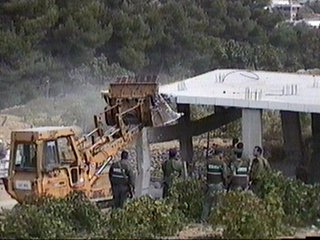 Soldiers supervising demolition (Not related to the case) Before 1967 Anata was connected to neighboring villages -- Hizma to the north, Shu'fat to the west, and al Issawiya to the south -- all of which bounded the northern peripheries of Jerusalem. Its residents made their living from its 30,542 dunams of agricultural land and from stonecutting. Following the 1967 war, half of Anata was incorporated into the expanded municipal boundaries of Jerusalem and half was left as a part of the West Bank. About a third of its population of some 12,000 hold Jerusalem identity cards, while the other two-thirds are classified as West Bank residents, with no access to Jerusalem -- including "Jerusalem" parts of Anata -- in times of closure. In order to contain any possible expansion of the village, the Israeli authorities expropriated some 20,000 dunams from Anata in order to build the West Bank settlements of Alon, Kfar Adumim, Almon and Ma'aleh Adumim which, together with their service roads and the Anatot military base, completely circumscribe the village, which is isolated from its remaining agricultural lands. Most of Anata's work force has been forced to find employment in Israeli factories, although the effective blockade of the village from Jerusalem has made employment difficult. Confined to a small part of their traditional lands, crowding in Anata has become chronic. Some 23 demolitions orders have been served on Anata residents who have been unable to secure building permits yet have been forced by their intolerable conditions to build "illegally." Some of these orders have been issued by the Jerusalem municipality; others, where Anata expands into the Israeli controlled "Area C" of the West Bank, by the Civil Administration. Khamad Dandis studied in Jerusalem until the eleventh grade and Hoda until the eighth. They moved to Anata in 1992 after Khamad's father bought a small piece of land on the outskirts of the village, on a steep, barren and rocky slope that had never been cultivated. Khamad's father inquired about a building permit with the Israeli Civil Administration of the West Bank before registering the land, and was given to understand that acquiring a building permit would not be a problem. He thereupon registered the land in his name and submitted a formal application to build a house. In the interim the outskirts of Anata became part of "Area C," and when the Likud government came to power in 1996 it froze virtually all Palestinian building and inaugurated its current campaign again "illegal" Palestinian building. Khamad's father died at this time, and after four years of waiting in vain for the permit, of chronic crowding and an inability to continue paying rent, the Dandis family began building their "illegal" home. Without any outside financial support, helped only by loans from his family and from his salary, Khamad managed to raise $60,000 and to build the basic shell of his house. Although much remains to be done on the structure, the Dandis family has moved in. In early 1997 Khamad finally heard from the Civil Administration: his application for a building permit was denied on the grounds that the land was zoned exclusively for agriculture. Accompanying the reply was a demolition order. Today, together with more than twenty other families in Anata and more than a thousand throughout the West Bank and East Jerusalem, the Dandis family awaits the Israeli bulldozers. A number of houses in the vicinity have already been demolished, and the daily tension of waiting for the Israeli army, police and demolition crews to arrive is almost unbearable -- especially because no one knows when they arrive. "I was fired from my day job because I took off too much time guarding my house," Khamad says. "I now work as an Egged bus driver at night. Even though I earn less than I used to, at least I do not have to leave my family to face the Israeli army, police and demolition crews alone." This decision was made after an incident that illustrates the effect the Israeli government's demolition campaign has on ordinary Palestinians. "At the end of August [1997], officials of the Civil Administration came to investigate the building situation in Anata, escorted by soldiers. My small children went into panic and fright from the soldiers, but my five year-old daughter, Rian, ran to defend the house. She confronted the soldiers and yelled at them: 'If you touch our house, we'll call the police!'" Khamad smiles at the bitter irony. "Months later," adds Hoda, "the children still have fears and nightmares." |

|
|
|
|


